A Systematic Review of Robot Topological Semantic Mapping and Localization for Spatial Understanding
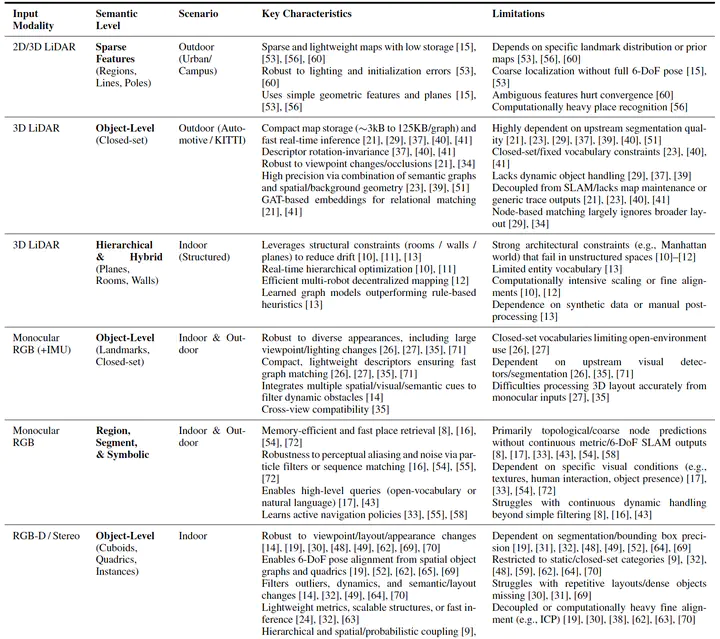 Image credit: Unsplash
Abstract
World representation is a fundamental robotics problem. Topological semantic maps compress complex environmental data into lightweight graph structures enriched with semantic information, forming compact world models that support high-level reasoning and advanced autonomy. Despite their scalability advantages over metric-semantic maps, they remain comparatively understudied. This review provides a comprehensive Preferred Reporting Items for Systematic Reviews and Meta-Analyses (PRISMA)-guided analysis of topological semantic maps, uniquely integrating their construction and localization aspects. The first part examines the map construction pipeline– semantic abstraction from sensor data, graph topology generation, map maintenance, and encoding. The second part covers localization strategies, including descriptor matching for place recognition, structural and semantic consistency checks for hypothesis validation, and probabilistic and geometric pose refinement. The paper concludes by discussing application advantages, persistent challenges, and future directions for spatial understanding AI.

Wei Zhu
Assistant Professor
My research interests include deep reinforcement learning, snake robots, wheeled bipedal robots, robotic arms, quadruped robots, humanoid robots, and social navigation.